
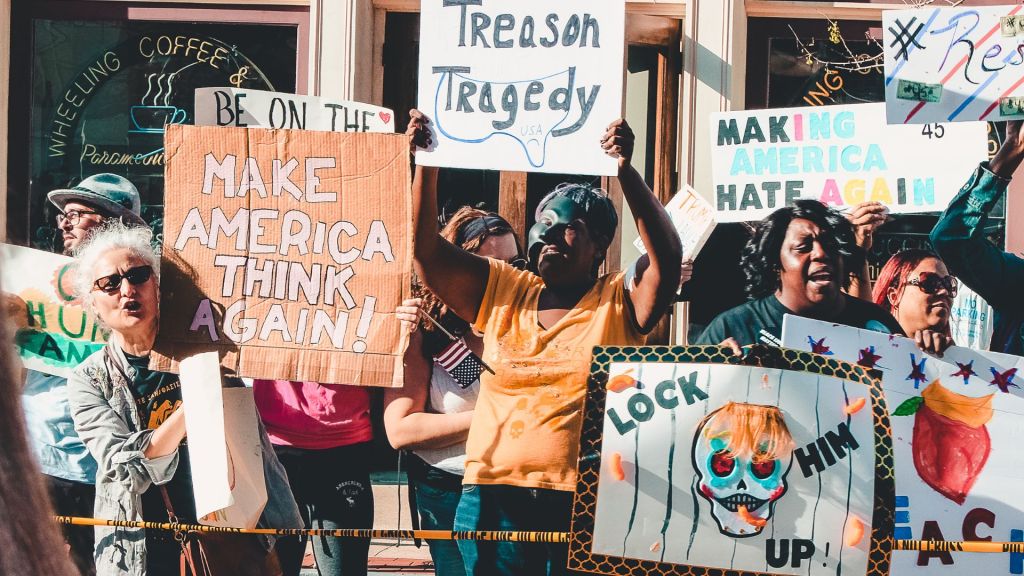
There’s a lot of noise out there right now—shouting, blaming, spiraling, hoping someone else will fix it. But here’s the truth:
We can’t wait for someone else to save us from Trump.
I don’t mean just Trump the person—I mean Trump the movement. Trumpism. The authoritarian, white nationalist, anti-LGBTQ+, anti-immigrant, anti-environment, anti-democracy machine that’s rolling forward with every election cycle, louder and more dangerous than the last.
And if you’re thinking, “What can I do, just one person?”—I get it. The problem feels huge. But it turns out, the answer is also you.
One Person Is Where Movements Start
The Trump administration didn’t rise from nowhere. It was built on decades of undermining public trust, gutting education, and pumping fear into politics. But it also succeeded because too many didn’t speak up until it felt too late.
We can’t afford to make that mistake again.
Every march, vote, donation, and conversation starts with one person deciding they care enough to act.
1. Acknowledge your privilege and use it wisely.
I’m a white, cisgender gay man. I live with freedoms and assumptions of safety that many of my friends, neighbors, and chosen family do not have. That’s privilege. And I own mine—not with guilt, but with responsibility.
Privilege doesn’t mean your life has been easy. It means certain barriers haven’t been placed in your path. When you understand that, you can start using your access, comfort, and safety to amplify others. Speak up when it’s safer for you than someone else. Step aside and make room. Fund causes that center the voices you don’t hear enough.
Start here:
- “Unpacking the Invisible Knapsack” by Peggy McIntosh: https://www.racialequitytools.org/resourcefiles/mcintosh.pdf
- Showing Up for Racial Justice (SURJ): https://www.showingupforracialjustice.org/
2. Vote and help others vote.
Voting is the absolute baseline of participation in a democracy—and it’s still being targeted and suppressed across the country. Your vote shapes who makes decisions about your body, your rights, and your future. But it doesn’t stop with you.
Help someone register. Offer a ride on election day. Volunteer to staff a polling place. Even texting your friends to remind them about deadlines makes a difference.
- Check your registration: https://www.vote.org
- Understand your ballot: https://ballotpedia.org
- Volunteer: https://www.whenweallvote.org
3. Call Your Senators and Representatives.
Calling your reps might feel awkward—but it works. Offices track constituent feedback daily, and a flood of calls can slow or shift legislation. You don’t have to be eloquent. Just state your name, ZIP code, and what you want them to support or oppose.
And remember: you’re not just speaking for you. You may be the only one calling on behalf of someone who can’t safely pick up the phone.
- Find your reps: https://www.congress.gov/members
- Scripts and tools: https://5calls.org | https://www.commoncause.org/take-action/
4. Donate where it counts.
You don’t have to be a millionaire to fund change. Organizations doing the most effective work often rely on small, consistent donations. Your $5/month pays for voter outreach, protest bail funds, educational materials, and more.
If you’re strapped financially, consider donating time or skills instead. Every contribution—financial or otherwise—adds fuel to the fire.
- Fair Fight Action: https://fairfight.com
- Run for Something: https://runforsomething.net
- Movement Voter Project: https://movement.vote
5. Speak up. Loudly. Repeatedly.
Your voice matters—and so does your silence. Whether you have 100 followers or 100,000, sharing truths and standing up for justice changes what’s “normal.” It shifts culture. It gives others permission to speak too.
Share articles. Correct misinformation. Elevate marginalized voices. And if you mess up? Apologize. Learn. Keep going.
- Media Matters: https://www.mediamatters.org
- SPLC’s Guide to Fighting Hate: https://www.splcenter.org/20170814/ten-ways-fight-hate-community-response-guide
6. Have hard conversations.
Change doesn’t just happen on Capitol Hill—it happens at dinner tables. Talk to your family. Your friends. Your coworkers. The conversations we avoid are often the ones that shift hearts over time.
Not every exchange will be easy or productive. But when someone you know and trust plants a seed, it tends to grow.
If it’s safe for you, lean in. Practice listening. Practice speaking. And remember that discomfort isn’t danger.
- Braver Angels: https://braverangels.org/
7. Support marginalized creators and local media.
The people most impacted by injustice are often the best equipped to lead us out of it. Support their work. Pay them. Share their art, writing, podcasts, and reporting.
Also, uplift independent and local journalism—it’s often where accountability starts. Truth-telling needs funding, too.
Why Your Action Matters
A 2020 study by the Knight Foundation found that personal outreach—texts, posts, conversations—was more effective than national ad campaigns.
Your voice moves people. Your courage creates momentum.
Study: https://knightfoundation.org/wp-content/uploads/2020/02/The-100-Million-Project_KF_Report_2020.pdf
This is a Fight Worth Having
Fascism doesn’t always show up in jackboots. Sometimes it shows up with flags and smiles. Then it bans books. Then it bans people.
Trump and his allies are promising all of it.
The Bottom Line?
You are not powerless. You are not small. You are not alone.
You might be someone’s lifeline. Someone’s first “yes.” Someone’s reason to hope.
So speak up. Act up. Show up.
Let’s build the future we actually want to live in—and refuse to surrender it to fear.
The Power of Storytelling
Stories are how we build empathy and pass down truth. When we share the stories of people who’ve been harmed—those detained, disappeared, or silenced—we ensure they are not forgotten.
But we also need stories of joy. Of progress. Of resistance. Of hope.
If you have a story, share it. If not, make space for someone else’s.
Because stories build the kind of world where everyone belongs.
Quick Actions You Can Take Today
- ✅ Check your voter registration: https://www.vote.org
- 📞 Call your reps: https://5calls.org
- 💸 Set up a $5 monthly donation to a justice org
- 📤 Share this message with 3 people
- 🗣️ Talk to one person this week about what’s at stake
Source Transparency & Context
To ensure transparency and provide context, here is information about some of the key sources mentioned:
1. “White Privilege: Unpacking the Invisible Knapsack” by Peggy McIntosh
- Political Leaning: Progressive
- Mission/Purpose: This seminal essay aims to highlight the unacknowledged advantages white individuals experience in society, fostering awareness and dialogue about systemic racism.
- Controversy: While widely cited in academic and social justice circles, some critics argue that the essay oversimplifies complex social dynamics and may not account for intersectional factors such as class and gender.
- Transparency: The essay is a personal reflection and is openly available through various educational institutions.
- URL: https://www.racialequitytools.org/resourcefiles/mcintosh.pdf
2. Showing Up for Racial Justice (SURJ)
- Political Leaning: Left-leaning/progressive
- Mission/Purpose: SURJ is a national network that organizes white people to engage in racial and economic justice work, aiming to undermine white supremacy and build a racially just society.
- Controversy: Some conservative outlets label SURJ as a far-left group, suggesting it targets white Americans to undermine their support of societal structures.
- Transparency: SURJ provides information about its mission, activities, and leadership on its official website.
- URL: https://www.showingupforracialjustice.org/
3. Vote.org
- Political Leaning: Left-of-center
- Mission/Purpose: Vote.org is a nonpartisan nonprofit that aims to increase voter turnout by providing accessible online tools for voter registration, absentee ballot requests, and election reminders.
- Controversy: In 2019, founder Debra Cleaver filed a lawsuit against Vote.org alleging wrongful termination and mismanagement. Vote.org denied the allegations, attributing her termination to erratic behavior.
- Transparency: Vote.org publishes its financial information and annual reports on its website.
- URL: https://www.vote.org
4. Ballotpedia
- Political Leaning: Nonpartisan
- Mission/Purpose: Ballotpedia is a nonprofit digital encyclopedia that aims to inform people about politics by providing accurate and objective information about politics at all levels of government.
- Controversy: Ballotpedia is generally considered a neutral source, though some critics argue that its reliance on volunteer contributors could lead to inconsistencies.
- Transparency: Ballotpedia provides information about its editorial policies and funding sources on its website.
- URL: https://ballotpedia.org
5. When We All Vote
- Political Leaning: Left-leaning
- Mission/Purpose: Founded by Michelle Obama, When We All Vote is a nonpartisan initiative aimed at increasing participation in every election by helping to close the race and age voting gap.
- Controversy: Some critics argue that its association with Democratic figures suggests a partisan bias.
- Transparency: The organization provides information about its mission, leadership, and activities on its website.
- URL: https://www.whenweallvote.org
6. 5 Calls
- Political Leaning: Left-leaning
- Mission/Purpose: 5 Calls is a civic engagement platform that helps individuals take political action by providing phone numbers, scripts, and issue summaries so users can quickly and easily call their elected officials.
- Controversy: The organization focuses on progressive causes, which may limit appeal or trust among conservative users. There have been no major public controversies about operations or leadership.
- Transparency: 5 Calls is transparent about how the platform works, offering clear descriptions of issue campaigns and how to get involved. However, detailed financial or organizational information is limited on their site.
- URL: https://5calls.org


 Tommy Karr